| In summer the President's Bodyguard changes guard and this can be seen from outside the gate. One can only visit are the Durbar Hall, Ashok Hall, the Dining Room and the Mughal Gardens. The Durbar hall served as a museum for several years until the building, which now houses the National Museum, was constructed.
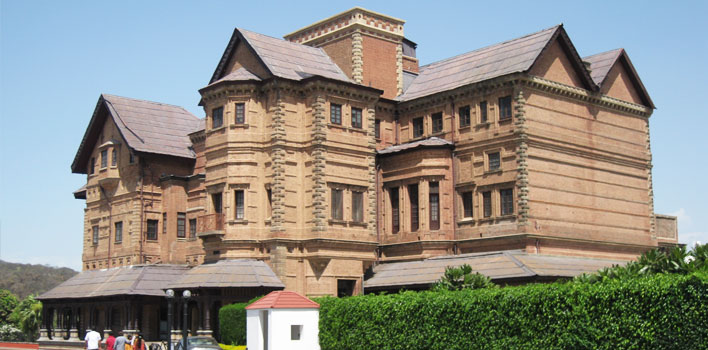
As dawn breaks over the Yamuna, streaks of pale golden rays embrace the tall magnificent granite structures on Rajpath. Rashtrapati Bhavana, the creation of two British architects-Edwin Lautyens and Herbert Baker was completed in 1931. The road down Rajpath is deserted other than a few early morning joggers, and the flutter of a flight of pigeons.
The President's Bodyguard (PBG) is the oldest and senior most unit of the Indian Army and the President's personal troops. The Viceroy's Bodyguard split in 1947 with the partition and one third went to Pakistan. On India becoming a Republic in 1950, with Dr. Rajendra Parsad as its first president, it came to be known in its present form as The President's Bodyguard.
As it nears 0630 hrs, the sound of music, marching of footsteps and hoof beats arise from within the complex and a contingent of a Rajputana Rifles (Infantry) Battalion and mounted troops of The President's Bodyguard (PBG) accompanied by a brass band in colorful maroon berets of the parachute Regiment, emerge on to Rajpath, marching to the strains of "Vijay Bharat".
On every Saturday a ceremonial changing of the guard takes place. Changing of the guard is a military tradition whose origins are lost in antiquity and from time immemorial, guards and sentries at forts, palaces and defense establishments change daily to enable a fresh body of soldiers to take charge. Soldiers of the band and marching contingents are assigned from different regiments for duty over a short period of time in rotation but the mounted troops are permanently stationed at the Rashtrapati Bhavan.
While the guard at Rashtrapati Bhavan changes daily, every Saturday a traditional military ritual of guard changing is conducted with precision and solemnity at a fixed time and place.
The PBG performs dismounted ceremonial duties at the Rashtrapati Bhavan, adding that touch and grandeur without which State functions would lose much of their impressiveness.
The spacious plaza at the foot of Rashtrapati Bhawan is known as Vijay Chowk. Rashtrapati Bhawan, is really part of the new urban complex built after King George V announced in 1911 that the British would shift their capital from Calcutta to Delhi. The Old Guard marches off to "Sare Jahan Se Achha". Compliments are paid by the New Guard, which assumes charge and the balance of the New Guard marches off along with band playing "Amar Jawan".
This short spectacle of colour and martial music, horse and man, rifle and lance, bugle and brass, traditions and trumpets leave a distinct feeling of nostalgia grandeur and pride for being a part of it all. It covers the same area as the Trafalgar Square in London.
| |